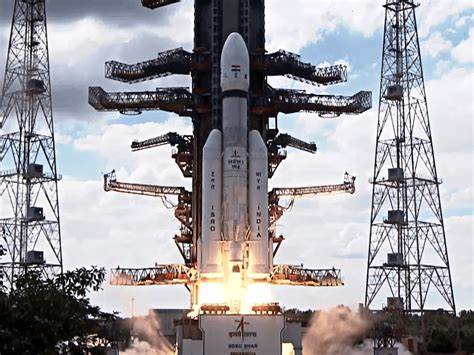
Chandrayaan-3 is India’s third lunar mission, and the second attempt at achieving a soft landing on the moon’s surface. The mission was launched on July 14, 2023, from the Satish Dhawan Space Centre in Sriharikota, Andhra Pradesh. It consists of an orbiter, lander, and rover. The orbiter will study the moon’s surface and atmosphere, while the lander will attempt to soft land near the lunar south pole. The rover will then deploy from the lander and explore the surrounding area.
The Lander
The lander is called Vikram, after the founder of the Indian Space Research Organisation (ISRO). It is a four-legged vehicle that is about 1,500 kilograms in weight. It has a variety of scientific instruments, including a camera, a magnetometer, and a seismometer. The lander is also equipped with a radar altimeter, which will help it to land safely on the moon.
The Rover
The rover is called Pragyaan, which means “wisdom” in Sanskrit. It is a small, two-wheeled vehicle that is about 26 kilograms in weight. It has a variety of scientific instruments, including a camera, a spectrometer, and a drill. The rover will be able to travel up to 500 meters from the lander and will explore the surrounding area for signs of water and other resources.
The Orbiter
The orbiter is called Chandrayaan-3 Orbiter. It is about 2,379 kilograms in weight and has a lifespan of one year. It has a variety of scientific instruments, including a camera, a spectrometer, and a magnetometer. The orbiter will study the moon’s surface and atmosphere, and it will also relay data from the lander and rover back to Earth.
The Timeline
The Chandrayaan-3 mission is scheduled to land on the moon on August 23, 2023. The rover will then operate for one lunar day, which is about 14 Earth days. The orbiter will continue to operate for one year.
The Significance of the Mission
The Chandrayaan-3 mission is significant for a number of reasons. It will be India’s second attempt at a soft landing on the moon, and it will be the first mission to land near the lunar south pole. The mission will also help to further our understanding of the moon’s history and geology.
The lunar south pole is a particularly interesting area for exploration because it is thought to be rich in water ice. Water ice is essential for life, and it could also be used as a resource for future missions to the moon. The Chandrayaan-3 mission will help us to better understand the lunar south pole and its potential for future exploration.
The Future
The success of the Chandrayaan-3 mission would be a major achievement for India and would help to further the country’s space program. It would also pave the way for future missions to the moon, including missions that would involve humans.
The Chandrayaan-3 mission is an exciting and ambitious undertaking. It has the potential to make significant contributions to our understanding of the moon and to help to further India’s space program. The success of the mission would be a major achievement for India and would be a source of pride for the country.
In addition to the scientific objectives, the Chandrayaan-3 mission also has a number of technological objectives. These include:
- Testing and validating new technologies for lunar exploration, such as the lander and rover.
- Developing and demonstrating new methods for soft landing on the moon.
- Improving India’s ability to operate spacecraft in cislunar space.
The success of the Chandrayaan-3 mission would be a major boost for India’s space program and would help to position the country as a leading player in the global space race.



 Brahm Beyond
Leave a comment